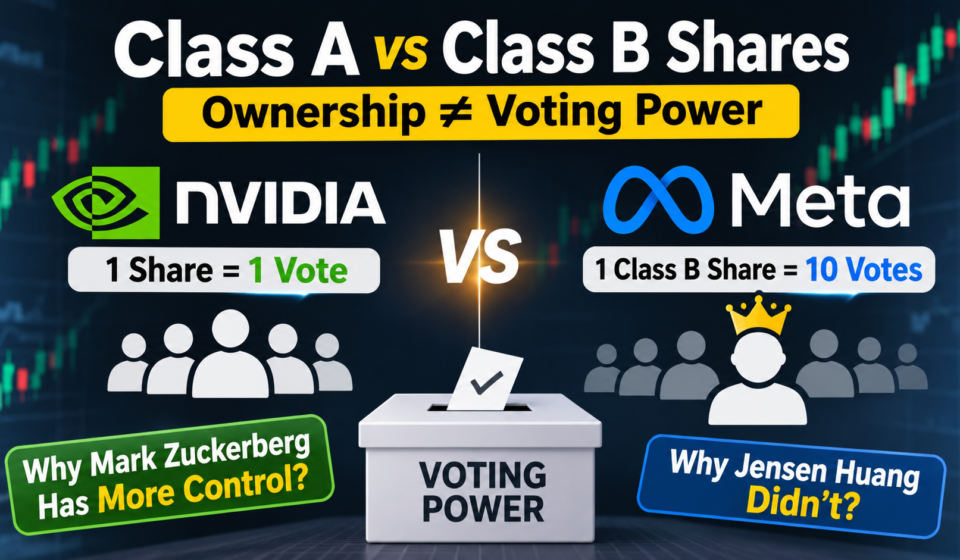
Class A vs Class B Shares: Differences, Voting Rights & Examples
What Are Class A and Class B Shares?
When you buy a company’s stock, you become a shareholder. But did you know that not all shares come with the same voting power?
Some companies issue different types of shares, such as Class A and Class B shares. Although both represent ownership in the same company, they can provide different voting rights.
This structure is especially common in technology companies where founders want to maintain control over business decisions even after selling shares to the public.
Let’s understand how it works.
Class A Shares: What Are They?
Class A shares are a type of company stock that generally comes with voting rights.
However, the exact voting power depends on the company’s share structure.
For example, at Meta:
- Class A shares generally provide 1 vote per share.
- They allow public investors to participate in shareholder voting.
- Investors can vote on matters such as board appointments and important company decisions.
Class A shares are commonly available to public investors.
Class B Shares: What Are They?
Class B shares can provide greater voting power than Class A shares.
Many companies use this structure to give founders and early investors more control over the business.
For example, Meta’s share structure gives:
- Class A shares: 1 vote per share.
- Class B shares: 10 votes per share.
This means someone holding 1 million Class B shares can have the same voting power as someone holding 10 million Class A shares.
That’s a major difference!
Mark Zuckerberg: How Class B Shares Give Him More Control Over Meta
A perfect example of dual-class shares is Meta Platforms.
Mark Zuckerberg owns a relatively small percentage of Meta’s total economic ownership compared with the company’s entire shareholder base. However, his Class B shares give him significantly greater voting power.
According to recent reporting, Zuckerberg controls approximately 60% of Meta’s voting power despite owning around 13.4% of the company. Fortune+1
What does this mean?
Even if thousands of public shareholders disagree with Zuckerberg’s decisions, they cannot simply outvote him on matters decided by shareholders.
His voting control gives him enormous influence over board appointments and the company’s direction.
This is why founder-controlled companies can be difficult for outside shareholders to influence.
NVIDIA vs Meta: Why Jensen Huang’s Situation Was Different
The recent departure of Jensen Huang from NVIDIA provides another interesting example.
On November 12, 2026, NVIDIA announced that Huang had resigned as CEO and a member of its board. Colette Kress was appointed interim CEO. NVIDIA Announces CEO Transition+1
But why was his situation different from Mark Zuckerberg’s?
The key difference is voting power.
NVIDIA follows a one-share-one-vote structure. Huang owned approximately 3.58% of the company, meaning his shares did not give him special voting privileges. Fortune
Unlike Zuckerberg, Huang did not have super-voting shares that could protect his control over the company.
The important lesson: Being a company’s founder or CEO does not automatically mean you control its board. Your ownership percentage, voting rights and the company’s governance structure all matter.
Class A vs Class B Shares: Key Differences
| Feature | Class A (Meta) | Class B (Meta) |
|---|---|---|
| Voting power | 1 vote | 10 votes |
| Ownership | Yes | Yes |
| Public availability | Generally available | Mainly founder-controlled |
| Control | Lower voting power | Higher voting power |
Note: Share rights differ between companies. This table uses Meta as the example.
Why Should Investors Care About Share Voting Rights?
Before investing in a company, don’t just look at its stock price, revenue or growth potential.
You should also understand its ownership and voting structure.
Here are three things to consider:
- Founder control: Does the founder have enough voting power to influence major company decisions?
- Shareholder rights: Can ordinary investors influence board appointments and corporate decisions?
- Corporate governance: Is decision-making concentrated in the hands of one person or shared among shareholders?
A company with strong founder control may make long-term decisions without worrying about short-term shareholder pressure. However, it can also limit the influence of ordinary investors.
Final Thoughts
Class A and Class B shares show that owning company stock and controlling a company are two different things.
NVIDIA and Meta provide a clear example. Jensen Huang did not have special voting rights at NVIDIA, while Mark Zuckerberg’s Class B shares give him substantial control over Meta.
Remember: When investing in stocks, don’t just ask how many shares you own. Ask how many votes those shares give you.
Disclaimer: This article is for educational purposes only and is not financial advice. Always do your own research before investing.